
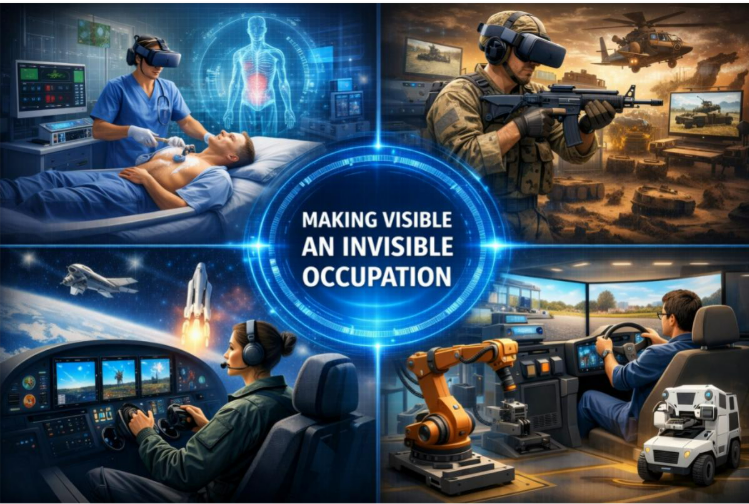
Simulation – making visible an invisible occupation
Why simulation work matters – and why it’s missing from the data
Collecting the evidence to recognise simulation as an occupation in Australia
Simulation is everywhere in Australia – healthcare, defence, engineering, education, transport, energy, and games. The simulation industry is estimated to contribute between $14 and $22 billion to the national economy. Yet the people who design, run, facilitate, and analyse simulations remain largely invisible in official workforce data.
This raises some simple but critical questions:
- Who is currently working in simulation roles?
- Where are they employed?
- How do they describe their skills when seeking work?
- And how do employers know those skills meet the standards required for safe, effective, and ethical simulation practice?
Right now, Australia can’t answer these questions reliably.
What’s missing – and why it matters
Australia relies on national systems to track occupations and workforce capability, including:
- Occupation Standard Classification Australia (OSCA)
- Jobs and Skills Australia
At present, “simulation” does not appear as an occupation (or under consistent variants) in either system. This absence has serious consequences:
- The simulation workforce cannot be accurately identified or measured
- Supply, demand, and skill shortages cannot be analysed
- Workforce planning and capability forecasting are constrained
- Career pathways for simulation professionals are unclear or ad hoc
- Organisations face increased risk—economic, reputational, and sometimes life‑critical—from poorly designed or poorly governed simulation
In short: when simulation work is invisible, accountability and capability suffer.
A timely opportunity: the 2026 Census
The 2026 Australian Census provides a rare opportunity to begin changing this.
Simulation Australasia’s Professional Development and Career Path Team is leading work to ensure that simulation is recognised as a distinct form of work – by encouraging people who do simulation work to name it as such in the Census, and by building the evidence base needed for future inclusion in OSCA and Jobs and Skills Australia classifications.
Census recognition is only the first step, but it is a critical one.
What work is underway?
To make simulation visible as an occupation, several strands of work are being developed in parallel.
Defining simulation as professional work
A defensible, occupation‑level definition is essential. One draft definition proposes:
Simulation (occupation) is a professional practice centred on the design, operation, facilitation, and analysis of constructed representations of real or hypothetical systems, used to support learning, decision‑making, testing, rehearsal, or systems analysis.
Simulation is defined by method, not by industry or tool. Practitioners apply expertise in abstraction, fidelity, scenario logic, and structured evaluation to enable safe exploration of performance and outcomes.
Identifying what makes simulation work distinctive
An initial set of defining characteristics includes the ability to:
- Design, validate, and govern simulation models and scenarios
- Configure and operate live, virtual, constructive, and hybrid simulations
- Manage ethical conduct, psychological safety, and exposure risk
- Capture data and lead structured debriefing and analysis
- Advise organisations on appropriate and responsible use of simulation
Building workforce evidence
This includes collecting data on:
- Education and skill requirements
- Typical training, qualifications, and experience
- Levels of responsibility and skill complexity
- Where simulation professionals are currently employed
- Job advertisements, workforce surveys, and industry reports
How members can support this work
This effort depends on participation from the community.
✅ If you work in simulation, describe your work as “simulation” in the 2026 Census
✅ Talk with colleagues and employers about why naming simulation work matters
✅ Watch for future opportunities to contribute workforce data or case material
Making simulation visible is about more than recognition—it’s about capability, ethics, safety, and the future of our profession.